Understand your audience
How to Find Viewer Questions in YouTube Comments
Viewer questions do not always end with a question mark. They often appear as requests for an example, a statement of confusion, or a comparison with another solution.
In short
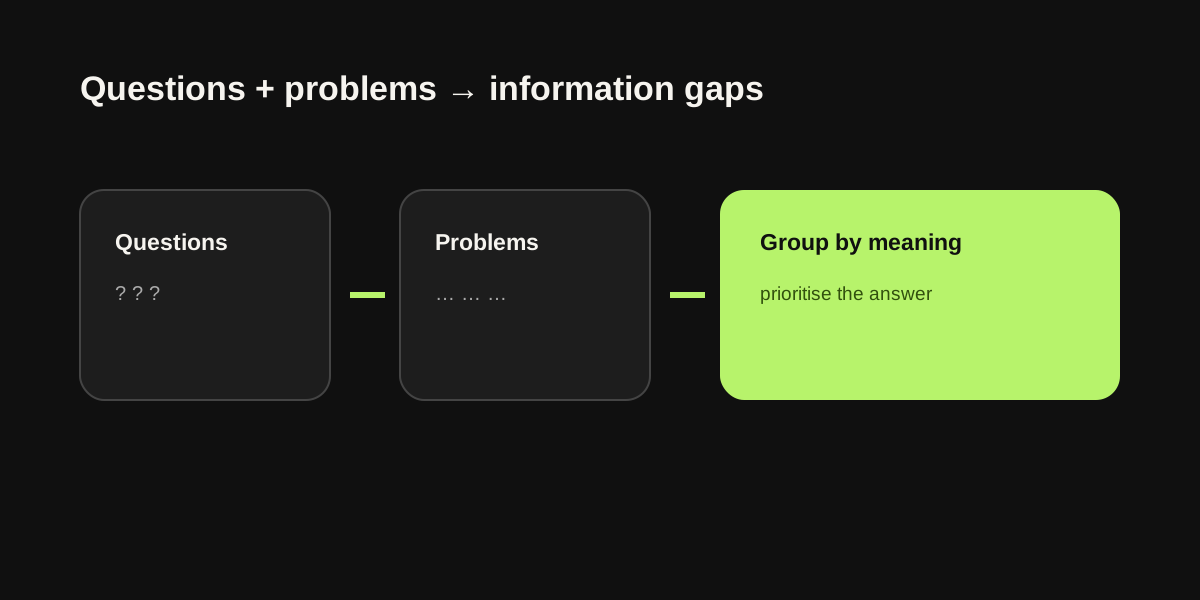
Viewer questions are not just sentences with question marks. They are recurring information gaps expressed through questions, problems, and concrete requests.
Separate explicit and implicit questions
An explicit question asks directly about a process, decision, or detail. Implicit questions are harder to spot and often more valuable. Statements such as “this does not work for me” or “can you show this with X?” both describe an information gap.
Group questions by meaning
Many viewers ask the same thing with different vocabulary. Good grouping connects meaning, not just matching words. “Which setting should I use?” and “Why does mine look different?” may belong to the same explanatory need.
Give each group a clear sentence that someone outside the comment section can understand. That sentence becomes the core of the eventual video idea.
Demand and usefulness create priority
A frequent question is an obvious signal. A less frequent but very specific question can matter too when it describes a recurring obstacle. Combine frequency, different viewers, likes, and feasibility instead of relying on one metric.
- How often does the need appear independently?
- How many different viewers are involved?
- Is the problem likely relevant beyond the commenters?
- Can one video answer it clearly and completely?
Evidence makes prioritisation trustworthy
A list of topics without original voices is difficult to verify. Show at least one representative comment and the key numbers for each topic. This makes it clear whether a topic is genuinely repeated or simply sounds convincing.
A practical classification system
Four categories help with a first pass: understanding, implementation, comparison, and request. An understanding question asks for an explanation, an implementation question describes an obstacle, a comparison question weighs alternatives, and a request asks for an example or follow-up video.
The categories are useful because they point to the right answer format. Understanding needs explanation, implementation needs steps, comparison needs criteria, and a request needs an editorial decision about scope and format.
Turn questions into a complete answer
For every strong question, write the concrete statement your video should prove or explain. Then decide which examples, screen recordings, or tests are needed. This turns a list of questions into a clear narrative.
When several questions point to the same underlying problem, answer them together. That avoids a string of very short videos and gives viewers a complete solution instead of isolated fragments.
A checklist for prioritisation
Begin with a complete list before you score questions. Mark whether each statement is explicit or implicit and which information gap it represents. This prevents only comments with question marks from entering the analysis.
Then evaluate groups by reach, clarity, and usefulness. A question is especially valuable when different viewers raise it, the problem is concrete, and a clear answer is possible. Also record questions you deliberately do not prioritise so the decision remains transparent.
- collect explicit and implicit questions
- group by meaning rather than wording
- separate different viewers
- estimate answer value
- document deliberate exclusions
Why the most frequent question is not always best
A frequent question may be broad and easy to answer in one sentence. A less frequent question may point to a persistent obstacle shared by many silent viewers. Combine frequency with expected usefulness and the clarity of a possible solution.
Also check whether the question fits your channel. A strong analysis does not only produce a ranking; it explains why a topic matters to this audience. That helps you balance reach, expertise, and the actual needs of your community.
Finally, write the answer so it remains clear without the original comment. This is a useful quality test for your grouping: if the problem cannot be explained in one precise sentence, the category may still be too broad or may combine several different needs. Add a short example when helpful so silent viewers can recognise the practical value immediately. Also check whether the answer depends on a current version, setting, or platform feature and make that limitation explicit.
Frequently asked questions
How do you find hidden questions in YouTube comments?
Look beyond question marks for problems, confusion, comparisons, and requests for examples. A statement such as ‘this does not work for me’ can reveal a specific information gap.
How should similar viewer questions be grouped?
Group by shared meaning rather than identical words. Give each group a clear sentence describing the underlying need in language that makes sense outside the comment section.
Which viewer question should you answer first?
Prioritise independent frequency, the number of viewers affected, practical value, and whether one clear video can answer the question completely.